

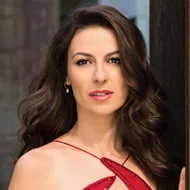
« The most difficult step when learning a new role is the first note. »
The Israeli soprano Chen Reiss grew up in Cholon and Herzliya and began her vocal training at the age of fourteen. She completed her military service as a solo singer with the orchestra of the Israel Defense Forces (Zahal). She continued her training in New York and made her debut in 2000 as Mademoiselle Silberklang in Mozart's The Impresario at the "World Bank Mozart Festival". In 2002 she made her debut at the Bavarian State Opera and in November of that year sang Gustav Mahler's Symphony No. 8 at Carnegie Hall. She was engaged by the Vienna State Opera and has since sung at the great international opera houses and concert halls.
Classicpoint.net: You completed your military service as a solo singer with the orchestra of the Zahal and so launched your career. Could you tell us something about that?
Yes, there I sang everything, from opera arias to chansons by Edith Piaf to Israeli pop music. The first three weeks were the most difficult, because of the basic training. I learned to shoot with three different weapons, I slept very little, had to do a lot of sport, clean the kitchen, guard the barracks and be able to put on a gas mask in eight seconds. But I think it is the best school for life.
What fascinates you about singing, what do you love about your profession?
When it comes to the voice, there is never a dull moment. Every day, every role, even simple songs can sometimes present challenges. Sometimes musical, sometimes dramatic, sometimes technical. Often all three. I must not take anything for granted; sometimes you think, yes, now I have understood everything and have everything under control, and then suddenly things can go wrong. We are artists, not technicians, and must create something fresh and new every day. It keeps me on my toes, and I find that fascinating. You simply have to practise, practise, practise, keep learning constantly, and when everything then works effortlessly on stage, that feeling is simply a great joy and a pleasure. Soul and body become one; that is what I love most.
What are your greatest challenges?
There are very many challenges. Learning the art of singing and developing these skills requires years of hard work, and it never really ends. That is the technical side. You have to learn many new roles and pieces; some are musically demanding, others dramatically, and all of this must, depending on the case, be done under time pressure. Then there is, of course, the competition; there are a great many outstanding singers. In addition, you must always stay fit and healthy. I also find it difficult to reconcile family with a profession that demands such great physical and mental commitment and requires so much travel. I am the mother of two young children and a wife, and both my family and friends as well as the theatres and orchestras have expectations of me. That leaves very little time for myself. But I don't want to complain; I am very happy to have everything.
How do you go about studying a new opera role?
The most difficult step when learning a new role is the first note. Having the courage to open the score and start from zero. I am always a little nervous before I learn a new role, but once you are into it, it is like riding a bicycle; I have the necessary learning skills.
You recorded the soundtrack for the film "Perfume" with the Berlin Philharmonic under Sir Simon Rattle. What was the collaboration like?
The orchestra had already recorded the music and I then sang along to it. The wonderful sound of the orchestra inspired me greatly, and the director had a clear idea of the sound he would like from me. I love this soundtrack; I find it very beautiful and well suited to the film.
You also sang at the Christmas Mass in St Peter's Basilica in front of the Pope. How was that experience for you?
Singing for the Pope was a highlight for several reasons. The "Et incarnatus est" from the Mass in C minor is, in my opinion, one of the most beautiful and moving arias Mozart ever wrote. Meeting Pope Francis was a very special and inspiring experience. You feel that you are in the presence of a great man who is warm, kind and caring. He wrote me a long, attentive and very personal letter. Of course I was very excited and nervous to sing in the church and via live broadcast in front of millions of people, but I knew that God would not forsake me, especially not in that moment.
You are Israeli but no longer live in Israel. How is your connection to your homeland, and are you also interested in political developments in your country?
Unfortunately I am not at all satisfied with the political developments in Israel. I am also very pessimistic about the future of the country. There is a great deal of corruption, very many social problems, fear and mistrust. In my opinion, this leads to people voting for the wrong candidates.
What are your current projects?
At the moment I am mainly working on the role of Ginevra in Handel's Ariodante. It is a new role for me, a long role, dramatically and musically demanding. I am very much looking forward to working with Sir David McVicar and Maestro William Christie. At the same time I am preparing orchestral songs by Richard Strauss, which I will sing for the first time in London. So two very different styles, which I almost have to sing with two different voices. In Handel there are many fast coloratura passages; you must sing very precisely and react quickly. In Strauss there are long arcs, long phrases, and you must sink into the harmonies and merge with the orchestra. It is a completely different use of language. As I said, no dull moments, but a lot of memorising.
Which roles you have not yet sung would you most like to sing one day?
Some of my dream roles would be, for example, Konstanze (The Abduction from the Seraglio), Amina (La Sonnambula) and Giulietta (I Capuleti e i Montecchi), to name just a few.
Interview by Florian Schär | Classicpoint.net | 1.3.2018
More interviews
All interviews →


