

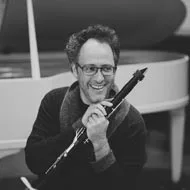
«I seek the deepest truth in music.»
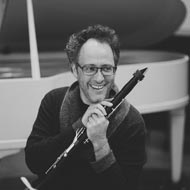
He made his debut with the Israel Philharmonic Orchestra under the baton of Zubin Mehta. Since then he has performed with several of the most important orchestras in the United States, Europe and Japan, including the Israel Philharmonic, the Tokyo Symphony Orchestra, the European Soloists, the Heilbronner Kammerorchester, the Moscow Virtuosi, the Jerusalem Radio Orchestra, the MDR Philharmonie Leipzig, the NDR Sinfonieorchester Hamburg and the Deutsches Symphonie-Orchester Berlin.
Today Chen Halevi is regarded as one of the world's leading clarinet virtuosos, who performs song recitals, concertos and chamber music with equal success. He is known for his impressive repertoire, which ranges from the most demanding contemporary music to early music on authentic period instruments.
How did you first come to study classical music, and when did you decide to become a professional?
I was born in the Negev Desert. At that time, rural areas had a progressive and active education system due to the socialist philosophy within Israeli society, which allowed me to begin my musical training at a high level from an early age. The local conservatives were very active in the community, and it was common for children to receive a musical education. I was fortunate that my first clarinet teacher was the legendary Itzhak Katzap, who had just escaped from communist Romania and landed in the small desert town where I happened to be born. My career as a soloist began quite quickly, so I never really made a conscious decision to become a professional musician; instead I followed a rather natural path.
You have developed your own school of clarinet playing. Could you explain this to us?
When I began my studies, there were still quite different clarinet schools, each of which used different materials and had its own unique concept of sound. These schools even had their own editions produced for their different interpretive traditions. I was fortunate that my two clarinet teachers came from very different schools – one from Eastern Europe and the other from America. My last clarinet lesson took place at the age of 16, and after that I was taught by composers and musicians who mainly played string instruments. This enabled me to go beyond the clarinet itself and use it instead as a tool for conveying a greater artistic expression. I always tried to imitate other instruments and even to bring non-musical experiences into my playing. I began to play both modern music and old instruments, and from this mixture came some strong ideas that made me appear very marginal at the time and not representative of the clarinet world. I would say that the ideas I had 30 years ago, which were largely criticised and not accepted, have since become much more commonplace.
Do you strive to be different in some way?
I never think about it. I always try to listen to my inner voice and seek the deepest truth in the music I play. In my performances, I also want to create unique, fleeting moments of emotion. I always imagine a soap bubble that takes all of us, both the players and the audience, on a unique, brief journey. The result often sounds different from other interpretations, but that is an outcome and not something I aim for.
Will classical music survive in 100 years?
Yes, but in what form is, of course, hard to imagine. Will it be a small niche, just a fraction of the endless noise people may have around them, or will it once again become a broader popular art form? In my view, humanity will be incredibly different in the future from today, partly due to technological progress. And perhaps, who knows, we may even be living on other planets! But in any case, I believe that Bach will find his way into the future.
If you could choose a deceased composer to ask a few questions, who would it be and what questions would you ask?
I believe, like many musicians, I have strong ideas about the composers we play. We hold an intimate dialogue with composers every day and feel that we know them well. I firmly believe that it would not surprise me to meet famous composers, since I feel I already know them so well through their music. But I would like to spend a week with Mozart, Da Ponte and Casanova – not asking questions, but simply having fun!
You come from Israel and now live in Germany. What are the most important differences for you?
I would say that these are two societies based on opposing approaches. Israel is built on permanent chaos and improvisation, while Germany is founded on order and planning. This of course makes the way the music world functions very different. I would say that in Germany you have better chances of finding rewarding work as a musician, but Israel may be a better place to develop your artistic curiosity as a child. So I would perhaps jokingly say that it may be good to learn music in Israel, and when you are 18, you should move to Germany!
How are you dealing with the current Corona situation?
I believe Corona was a major crisis that one has to adapt to. For musicians it was a terrible blow to their professional existence. I admit that it breaks my heart to think that all musicians around the world pick up their instruments every morning and try to preserve their faith and their form in our art, without the opportunity to do what they were trained for – to perform on stage – and without any prospects for the future. I feel especially sorry for the young generation, who are beginning their path only to find all doors closed in front of them. Personally, I was very dismayed by the inability of the world's leading politicians to understand our situation and to find ways to help us. I think performing artists are the greatest victims of this crisis – probably together with small businesses. It is also sad to have to observe that the world's leading politicians are almost without exception absolutely ignorant of every form of art and its significance for human existence. To tell the truth, we were abandoned without hesitation. Another point is that, contrary to what I thought before this crisis, I have realised that technology is not, and will never be, a substitute for human contact. To put it mildly, Zoom lessons are lacking, and I quickly gave up watching online concerts. It simply does not have that special feeling of sitting in a hall listening to an orchestra warming up in a delicious frenzy.
What are your projects?
My immediate project and concern is to keep helping our art survive. First of all, nowadays as a professor one needs a very different kind of attention in order to preserve faith in the future and not lose hope. So much other work should therefore be done to focus more on the psychological aspects. Equally important is finding ways to return to live concerts. At all the concerts played in recent months, I felt a great thirst for music, and the few tickets that could be sold disappeared quickly. It is important to know that the audience observed all hygiene regulations without difficulty.
Here in Switzerland we are preparing the seventh edition of the Mizmorim Festival in Basel for next January, with a wonderful programme. We are constantly striving to find ways to carry out all the festival's concerts and plans while complying with the constantly changing safety regulations.
What are your visions for the future?
I think the most important thing for me is to remain creative and to follow my artistic interests of the moment. The clarinet is only a pretext for staying alive and curious, and that is why I love moving between different musical genres. Early instruments, working with composers, creative tango playing, flamenco and oriental music help me stay alert. I can no longer play 20 Weber concertos and 20 Mozart concertos a year. Freedom is important to me, and I accept that I pay the price for it, given the way the business is run – but that is simply who I am.
What interests do you have besides music?
I have many other interests besides music, perhaps too many to choose from. But I would say that almost everything connected with art in its various forms – literature, poetry and essentially anything that lifts us above the bureaucracy of everyday life is probably something that passionately interests me.
Interview by Florian Schär | Classicpoint.net | 25 November 2020
More interviews
All interviews →


