

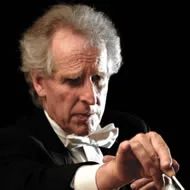
«Cassadó taught me for five years and never asked my parents for a single penny.»

The son of Jewish emigrants from Germany, he was already receiving composition and cello lessons as a child. The compositions of the nine-year-old caught the interest of Benjamin Britten, who invited him and his family to his home in Aldeburgh for three summers, where he received instruction in music theory and composition from Britten's assistant Imogen Holst, the daughter of Gustav Holst. From 1954 to 1959 he studied cello in Florence with Gaspar Cassadó, whom he also accompanied on concert tours. He studied at University College London until 1964. From 1967 he taught at the New England Conservatory in Boston, where he led the interpretation classes and conducted the New England Conservatory Youth Philharmonic Orchestra. Over 32 years he undertook thirteen international concert tours with the orchestra, made five commercial recordings and produced several television documentaries for the Public Broadcasting Service. Since 1979 Zander has been conductor of the Boston Philharmonic Orchestra. Alongside his musical activities, Zander gives lectures on leadership internationally, including several at the World Economic Forum in Davos. With his wife, the psychotherapist Rosamund Zander, he published the book The Art of Possibility, which has been translated into sixteen languages. In 2002 the International Council for Caring Communities (ICCC) honoured him as a "Caring Citizen of the Humanities".
As a child you had composition and cello lessons. Your compositions at the age of nine attracted the interest of Benjamin Britten, who then invited you and your family and gave you composition lessons. Can you remember this time, and what did you learn from him?
The experience with Benjamin Britten during the three summers I spent with my family in Aldeburgh had a great impact on me. I was still very young - between 10 and 13 - and he was very kind and encouraging. His warm, resonant voice still accompanies me in my ear. He was carefree and fun. We children spent a lot of time with him, driving around in his Rolls-Royce or heading out to sea in a small boat - with a boatman like Albert Herring. He had a playful, childlike quality that I have rarely encountered in a very famous person. One day I asked him: "How is it that you always have time for us?" He replied, with a serious twinkle in his eye: "I compose every morning from six until ten, and then I have time to play with my friends!" It was as if he were speaking from one child to another. I believe that was the beginning of my path of working with children and young people. It was Ben who first made me aware that making music spreads joy and radiance. He also taught me to fall in love with the connection between poetry and music. I think that in his mastery of setting words to music he is almost the equal of Schubert. I have kept this passion for the relationship between words and music to this day."
Since that time I have not composed a single note.
You also studied cello with Gaspar Cassadó and accompanied him on his concert tours. What experiences did you have with him?
Cassadó is my favourite cellist of all time. Listen to this magical performance of Chopin's Nocturne in E flat (4 minutes). Listen to the trills, the left-hand runs, the glorious tone (on gut strings), the amazing portamentos (gliding between notes) like a singer, the intimate phrasing, as if he were whispering in your ear. The great Spanish soprano Victoria de los Angeles said to me, when I was studying with Cassadó in Spain: "Pay close attention! Everything I know about singing I learned from Gaspar Cassadó." When I conduct an orchestra, I listen to Cassadó's sound. When I recorded Mahler's Second with the Philharmonia Orchestra, I played the entire orchestra his Chopin recording before we recorded the second movement. Suddenly the whole orchestra was transformed - the sound, the timing, the rubato, everything! That is how we learn from one generation to the next; it is an endless process.
Cassadó taught me for five years and never asked my parents for a single penny. "If I calculated the money for my lessons," he said to my father, "you could never afford it, so I won't charge you anything. Just imagine that!" Since then I have never again charged for a lesson. How could I? That is what is called "passing it on". What an incredible gift this great man gave me!
Do you still play the cello today?
Only occasionally now, to demonstrate something. I miss that "hands-on" experience of making music. But the cello is the heart of my music-making. People often say that the cello section of every orchestra I conduct shines with a special brilliance.
You have been conductor of the Boston Philharmonic Orchestra since 1979. What makes this orchestra special?
The musicians of the BPO play with an incredible sense of daring, spontaneity and willingness to take risks. I encourage them to "go for broke" - everyone thinks beyond the bar lines in what I call "ONE BUTTOCK PLAYING". The players of the Boston Philharmonic Youth Orchestra are just the same - they are full of awe and wonder as they tackle one great work of the repertoire after another, each for the very first time. After a four-hour rehearsal on Saturday afternoon they are as fresh and committed as at the start. Some of them travel from far away to take part in the rehearsals. One child is driven 5 hours each way from New Jersey by his mother! Just imagine how excited they will be when they come to Basel and Prague. Hamburg, Vienna and Berlin!
Alongside your musical work, you give lectures on leadership internationally, for example several times at the World Economic Forum in Davos. How did this come about?
I realised that leading an orchestra is similar to leading a company. The conductor makes no sound himself; his power comes from his ability to empower other people. His task is to awaken possibilities in others. This is a great model for any kind of leadership. Together with my former wife, the psychotherapist Rosamund Zander, we therefore developed a series of practices for keeping possibilities alive at all times and under all circumstances. We wrote the book The Art of Possibility, which has been translated into 26 languages and is used worldwide as a handbook for leaders.
How did it become so successful?
Many people are disillusioned with the old hierarchical, male style of leadership that has prevailed over the last 75,000 years. Winning and losing, success and failure, comparisons and measurements can only take us so far. Mandela and Martin Luther King, Gandhi and Jane Goodall were motivated by the vision of a better world for all, including the animal kingdom and the environment. I introduced the practices of possibility into the training of the Boston Philharmonic Youth Orchestra so that audiences at their concerts hear and see energy, generosity, inclusiveness, enthusiasm, vitality and love.
You gave an impressive TED talk about the transformative power of classical music. Why are you so sure that classical music will not die out?
I am not sure, but it is a better story than the one where everything goes to the dogs.
Where do you get the strength and energy for your work?
From the desire to share what I love and what I have discovered in my long life.
Interview by Florian Schär | Classicpoint.net | 01.06.2024