

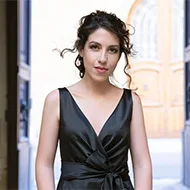
Born into a musical family, Beatrice Rana was already playing Bach's Piano Concerto in F minor in a public concert at the age of nine. At 16 she completed her piano and composition studies at the Conservatorio di Musica Nino Rota in Monopoli. She then studied in Hannover with Arie Vardi and in Rome at the Accademia Nazionale di Santa Cecilia. She attended masterclasses in Italy, France and the United States with Michel Béroff, Aldo Ciccolini, Andrzej Jasiński, François-Joël Thiollier and Elisso Wirsaladse.
She won first prizes at several national and international piano competitions. Among them were the Muzio Clementi Competition, the International Piano Competition of the Republic of San Marino and the Bang & Olufsen PianoRAMA competition. In 2010 Rana received the Arturo Benedetti Michelangeli Prize, and in 2011 the Montreal International Competition. At the latter competition she was additionally awarded all of the special prizes. In June 2013 Rana was awarded the 2nd Prize and the Audience Prize at the renowned Van Cliburn International Piano Competition.
Beatrice Rana is a soloist in high demand worldwide. She has already performed at the Tonhalle Zürich, the Konzerthaus Wien, London's Wigmore Hall, the Walt Disney Hall, the Washington DC Center, Ferrara Musica, the Auditorium du Louvre and the Lied Center of Kansas. Beatrice Rana is also internationally present at festivals such as the Verbier Festival, Radio-France Festival, Portland Piano Festival, Klavier Festival Ruhr, Toronto Summer Music and the La Roque d'Anthéron Festival. She has appeared as guest soloist with various international orchestras, including the Los Angeles Philharmonic Orchestra, the Detroit Symphony Orchestra, the London Philharmonic Orchestra, the Orchestra of the Accademia di Santa Cecilia, the RAI Symphony Orchestra Turin, the Dresden Philharmonic, the Filarmonica della Scala, the Maggio Musicale, with conductors such as Yannick Nézet-Séguin, Leonard Slatkin, Trevor Pinnock, Susanna Mälkki, Antonio Pappano, Fabio Luisi and Zubin Mehta.
Beatrice Rana is regarded as one of Italy's leading pianists.
How did you first get to know the piano, and why did you want to learn this instrument?
I began piano studies because both of my parents are pianists, so for me it was a completely natural, daily activity. For me, getting to know the piano was unavoidable and not special at all, because it was something I knew from home. It was a daily activity.
At the age of nine you were already performing piano concertos as a soloist. When and why did you decide to make it your profession?
Actually, the decision to make it my profession came gradually, precisely because my parents were already pianists. Fortunately, they did not want to push me to become a pianist, but as I grew older it became increasingly clear to me that music is an essential part of my existence, and that I would have liked to make it my profession. Being certain of this came only later, with competition victories such as in Montreal, which gave me the opportunity to make my great love my profession.
You live in Rome today. Do you perceive audiences differently in various European countries?
Yes, absolutely. I perceive each country very differently. Every nation has its own specific audience, and that is a beautiful thing despite globalisation. I have to say that every nation's audience has a very distinct character. For example, the Italian audience is a very, very warm audience, even if it is perhaps a bit more chaotic. The German audience obviously has a great culture of the whole German repertoire, which of course makes up a large part of the repertoire we play. In the United States the enthusiasm is different again, in the sense that European music is in a way new music for them. In Japan people are very religious, and so on.
Who are your favourite composers, and why?
I could not say that I have favourite composers, because I love everything I play very much and mostly decide spontaneously what I play. I cannot choose one composer, because I feel I would be doing injustice to another.
Do you also improvise when you play the piano?
I would love to be able to improvise at the piano. Unfortunately, it is not a talent I possess. I have not trained this ability, although I really admire people who can improvise, because it is something I would like to be able to do.
Are you also interested in other musical styles besides classical music?
Yes, I also like other genres of music very much. For me, music divides into good music and bad music. There is good classical music, as there is in other genres, and there is bad classical music, as there is in other genres.
Do you teach?
I do not teach regularly. From time to time I give a masterclass. These are occasions I enjoy very much, because I like being in contact with young people. For me it is a challenge, because I do not teach regularly. I also learn a great deal myself when teaching.
When is a lesson good, for teacher or student?
A good lesson is when a teacher is able to fully develop the nature of their student. I was lucky to have teachers who taught me with this ideal. They explained to me how I could play better, but they never contradicted my human nature. They never contradicted my nature as a musician, and that is very important to me.
What does music mean to you?
Music is life for me. I express myself far more through music than through words. Basically, the voice, both mine and that of many other people, is truly a universal language. This kind of communication makes it possible to connect people who do not know each other and to let them experience unique and unrepeatable emotions.
Besides music, do you have other passions and hobbies?
Yes, I am a person with wide-ranging interests, but certainly not at the level of music. Music takes up much of my energy and leaves little time for anything else. But I like reading, enjoy going to the cinema, walking, or visiting museums.
Interview by Florian Schär | Classicpoint.net | 20.09.2021
More interviews
All interviews →


