

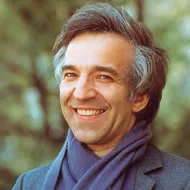
«I am always open to new things.»

Vladimir Ashkenazy, born in 1937 in Gorky, Soviet Union, today Nizhny Novgorod, began his musical career as a pianist and became world-famous as a conductor. At the age of six, Ashkenazy began piano lessons and later studied at the renowned Moscow Conservatory. In 1963 he emigrated with his family to England, and six years later to Iceland. Since 1982, Ashkenazy has lived in Switzerland. As a pianist he won numerous prizes and awards. His recording output as a pianist is extensive, as is that of hardly any other pianist. In the mid-1970s Ashkenazy began his career as a conductor. From 1987 to 1994 he was Music Director of the Royal Philharmonic Orchestra. From 1989 to 1999 he led the Deutsches Symphonie-Orchester Berlin as successor to Riccardo Chailly. He then held the post of Music Director of the Czech Philharmonic until 2003. Guest conducting engagements take him all over the world.
Classicpoint.ch: You grew up for the first 14 years of your life in an apartment eight square metres in size, two by four metres. The furnishings consisted of a parents' bed, a wooden partition with a table, and a piano. You shared the kitchen and toilet with four other families. What did music mean to you and what did it give you back then?
As a six-year-old boy I knew nothing else and was very happy. My father was a pianist, and when my parents asked me whether I would like to learn an instrument, it was clear that I would choose the piano. When my mother realised how quickly I was progressing at the piano, she introduced me to all kinds of music. Before long I was playing many piano reductions of operas and symphonies. I discovered a great deal and, as I said, I was very content.
You personally lived through the era under Stalin. In 2003 you launched the project "Prokofiev and Shostakovich Under Stalin".
Yes, I marked the 50th anniversary of Stalin's death by performing a concert of music by the composers Prokofiev and Shostakovich from that period. I tried to put together as broad a programme as possible, documenting the difficult period under Stalin for these composers. We took the programme on tour.
As you have said in an interview, you were never particularly interested in conducting. How did you nevertheless become a world-renowned conductor?
Even as a small boy I was much more interested in symphonic music than in the piano repertoire. I listened to far more recordings of symphonies than of piano concertos. I was indeed never particularly interested in conducting. I thought it was very difficult and that I had plenty of time to learn it. Later I was able to gain some first experience at charity concerts with the orchestra of my father-in-law, who was the conductor of an amateur orchestra. I did not plan to continue appearing as a conductor, as I thought it was too difficult. It was an "accident" that really led me to conducting. In the 1970s, Daniel Barenboim was scheduled to conduct two piano concertos, one with me and a second with Pinchas Zukerman. When Zukerman had to cancel, Daniel Barenboim spontaneously suggested that he take on the piano part and that I should conduct. Because I knew the concerto inside out, I agreed. After the concert, the orchestra asked me whether I would be interested in taking on guest conducting engagements from time to time. I have now been conducting for over 30 years.
Can your word, used deliberately as a world-famous pianist and conductor, also have an effect politically?
As a public figure I can draw attention to things and offer support. In my view, however, that is not enough to exert political influence. Money is often the power that determines political decisions. Nevertheless, I try again and again to draw attention to important matters, and I gladly commit myself to a good cause.
As a pianist and conductor, you have an especially broad, largely traditional repertoire. What is your view of contemporary music?
It is hard to find good contemporary works. There are, however, some truly good compositions that I like very much. I am always open to new things.
You are on the patronage committee of the "Stiftung für junge Musiktalente Meggen", which supports highly gifted young musicians. How did that come about?
I live in Meggen myself, and it is important to me to support young musical talent. When I was asked, I gladly agreed and supported the foundation's launch with a benefit concert.
You moved to Switzerland in 1978. What does this country mean to you?
Switzerland's central location in the heart of Europe is a great advantage for me, since I travel a great deal. I have many friends in Switzerland and have always loved the country.
Interview by Florian Schär | Classicpoint.ch | 25.03.2011
More interviews
All interviews →


