

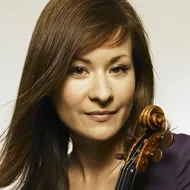
«Unfortunately, the music business is not only about music.»

Arabella Steinbacher was born on 14 November 1981 in Munich, the daughter of a Japanese mother and the music professor Alexander Steinbacher. She began violin lessons at the age of three; at nine she received a scholarship at the Munich University of Music and Performing Arts with Ana Chumachenco, who recognised her exceptional talent and nurtured it. Arabella Steinbacher has since achieved an international breakthrough and is counted among the most accomplished German violinists of her generation.
Classicpoint.ch: You grew up in Germany. Your mother is Japanese. What is your connection to Japan?
Japan is half of my home for me, and every time I am there, hear the language and breathe the air, a great many childhood memories come back. I spent almost every summer with my grandparents in Tokyo. Nowadays I only travel there to perform, but that feeling of coming home has always remained.
Where do you see the main differences in interpretations of classical music between Europe and Japan?
The Japanese revere Western composers very much, and many Japanese musicians therefore go to Germany to study and to be inspired by our culture. Even though Japanese musicians did not absorb our tradition with their mother's milk, I nonetheless sense their passion for European music.
You practise yoga and meditate a great deal. How does this affect your violin playing?
Before my performances it is very important to me to withdraw and to focus on my performance through meditation and breathing exercises, freeing myself from all external influences. This brings me closer to the music.
Do you always practise sitting cross-legged?
Yes, I learnt this way of practising from Ivry Gitlis. In hotels I always first look for a comfortable spot on the floor to practise and rest my violin on a chair. It is the most relaxing method for playing as loosely as possible.
When you perform, you often keep your eyes closed for long periods. Are you still aware of the audience, or do you try in some way to shut yourself off from it?
"Shutting off" is perhaps not quite right ... I try rather to free myself from externals that could distract me from the music, but I perceive the audience as energy and include it in my playing. It gives me a great deal in return, and it is like a give and take.
You learnt to play the violin using the Suzuki method. Your father would play for you on the piano, and you would play it back. Only much later did you learn to read music. Would you still recommend this path today?
For me it was very helpful to learn by ear, and, to be honest, I still learn fastest that way today, although I also have a visual memory. What I greatly value about the Suzuki method is the playful way children learn instruments, for example through group lessons with peers. The most important thing at that age is that making music is fun; otherwise children stop again quite soon.
You have not won any major competition. When was your personal breakthrough into a solo career?
From the age of eight I had the opportunity to perform regularly and to try out my repertoire in front of audiences, first in small settings with student orchestras and later increasingly with better-known orchestras. As a result, I was heard by many people, who in turn enabled me to make new contacts with promoters, agents and conductors, which was a great stroke of luck for me. Competitions are especially helpful when one does not have these performance opportunities.
You travel a great deal, often alone. What do you miss most about home when on tour?
Naturally I miss my family and friends most, but by now many of my friends are scattered across the world. Otherwise I try to pack a piece of home into my suitcase, small things like my diary or my yoga mat.
Where do you find balance to the classical world?
I love jazz, and when I am on concert tours I always look to see what jazz concerts are taking place there.
What is your view of historically informed performance practice?
As long as something is interpreted honestly and authentically, it convinces me; only when it sounds artificial do I have difficulty with it.
Is a permanent teaching post something you are considering?
One day I definitely want to pass on my experience to young talented musicians. There are many aspects beyond violin playing for which one must prepare young musicians and protect them from. Unfortunately, the music business is not only about music, and for that one needs strong nerves and people one can trust, who accompany one along this path.
Interview by Florian Schär | Classicpoint.ch | 2 February 2015
Photo: Robert Vano
More interviews
All interviews →


