

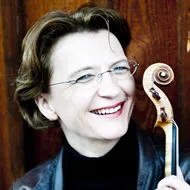
«That is everything I find in my violin by Peter Greiner.»
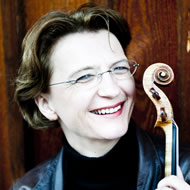
Antje Weithaas is one of the most sought-after soloists and chamber musicians of her generation. She is artistic director of the Camerata Bern, teaches as a professor at the Hanns Eisler Hochschule für Musik in Berlin and is a co-founder of the Arcanto String Quartet with Daniel Sepec, Tabea Zimmermann and Jean-Guihen Queyras.
Classicpoint.ch: You completed your musical training at the Hanns Eisler Hochschule für Musik in Berlin under Werner Scholz. Now you are yourself a professor at the Hochschule für Musik Hanns Eisler in Berlin. How did you experience this institution as a student, and how does it feel now as a professor?
That is very hard for me to compare. I studied at the Hanns Eisler music college in GDR times, in a dictatorial system. I naturally felt the lack of freedom of thought and the political pressure constantly. Fortunately, though, I had complete freedom musically. Alongside a fantastic education, I was very well supported from an early age, partly through the college, and was able to "try out" my ideas in concerts and gain important artistic experience. It is of course wonderful for me to teach today at my "former" college. The Hanns Eisler now enjoys an excellent worldwide reputation as a music training institution, the faculty is international and the artistic standard is very high. In the string department we have a wonderful atmosphere, and it is simply a pleasure to work with such talented students.
You play on an instrument by Peter Greiner from 2001. Would you exchange the violin for a Stradivarius, or does the cult surrounding old master violins mean nothing to you?
For me, what is interesting about an instrument is not its age or the name of the maker, but the quality of its sound. I am, so to speak, searching for "my vocal cords". Every musician pursues his or her personal sound ideal, seeks a wide palette of colours and flexibility in tone and, of course, an instrumental sound in which he or she expresses themselves personally and which speaks to the soul.
That is everything I find in my violin by Peter Greiner.
For the 2009/2010 season you took over the artistic direction of the Camerata Bern. How did you come to the Camerata Bern?
Chance played a part. Some years ago I stepped in at short notice as soloist and director for a colleague with the Camerata Bern. I remember a great atmosphere in the rehearsals and wonderful concerts. A few months later I then received a call asking whether I would be interested in the artistic direction. You can imagine that this surprised me greatly, but it also pleased me very much. Nevertheless, I gave the offer a great deal of thought. After all, the artistic direction of a chamber orchestra was entirely new to me. Today we are in our fourth season together, and I am very happy that the musicians of the Camerata have embarked on this "adventure" with me.
What do you appreciate about this ensemble, and where do you see its strengths?
I experience the ensemble as far removed from any false routine, always curious and with a great passion for music. Since the Camerata performs without a conductor to whom one could hand over responsibility, a truly chamber-music style of playing emerges: every individual contributes and is challenged as a creative musician. This way of making music is my ideal, whether in chamber music, as a soloist or, indeed, as the leader of a chamber ensemble. I believe that by now there is an almost instinctive understanding, a great joy in developing and playing together already during our rehearsals. Very intense, energetic and spontaneous performances result.
What visions do you have for the Camerata Bern?
We are always searching for exciting programmes for our audience in Bern and for our regional concerts and international tours. Without neglecting the core repertoire for string orchestra of the 18th to 20th centuries, I would like to continue the path we have begun, presenting symphonic works too, such as the Beethoven symphonies, to the audience from a transparent chamber-music perspective. A new focus of the ensemble since last season has been the exploration of baroque music on new historical instruments.
In addition, there is a welcome interest in commissioning new works for the Camerata Bern.
In 2002 you founded the ARCANTO Quartet with Tabea Zimmermann, Daniel Sepec and Jean-Guihen Queyras. Which of you took the initiative back then?
We had played together for many years in a wide variety of line-ups, had enormous fun doing so and were truly good friends. At some point it was only natural to devote ourselves together to the wonderfully beautiful string quartet repertoire.
All four of you are quite busy internationally. How much time do you set aside for quartet playing?
At the moment we play together for about four weeks a year, which means that we plan four phases for concerts and CD recordings spread across the year.
How does the rehearsal work go? Does someone take the lead, or does each of you spontaneously say what you would like done differently?
Of course, everyone contributes their ideas. We are a truly "democratic" quartet and can also really "argue" about musical interpretative nuances. In the end, however, we often find that we are not really far apart.
How long has been the longest break so far in which you have not touched your violin?
This summer, for example, I finally took a proper four-week break again. That was not possible for several years. But my violin and I quickly found each other again and were in harmony again, as usual, right from the first concerts.
Interview by Florian Schär | Classicpoint.ch | 7.10.2013
Photo: Marco Borggreve
More interviews
All interviews →


