

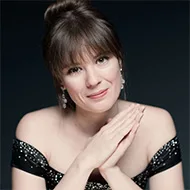
«For me, the most important thing is to immerse myself in the music.»
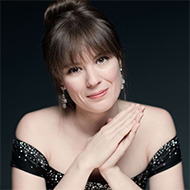
Anna Fedorova was born in Kiev on 27 February 1990, shortly before the collapse of the Soviet Union, and studied at the state Mykola Lysenko Kiev Music Lyceum and subsequently at the Royal College of Music in London. At the age of 16 she made her debut at the Concertgebouw in Amsterdam. In September 2013 she opened the "Sunday Morning" concert series at the Royal Concertgebouw with Sergei Rachmaninoff's Piano Concerto No. 2. This recording is one of the most-viewed versions of this Rachmaninoff concerto on YouTube, with over 34 million views as of 2022. Her first music albums were released in autumn 2014, and further albums followed in 2016. She performs in concert halls throughout Europe, North and South America and Asia, including with the Philharmonia Orchestra, the Royal Philharmonic Orchestra, the Bournemouth Symphony Orchestra, the Kyoto Symphony Orchestra and the Kanazawa Ensemble.
You began playing the piano when you were 4 years old. Both of your parents are pianists. Did you want to learn a different instrument from your parents?
Indeed, I was born into a musical family. My parents are both wonderful pianists and piano professors. Until recently they taught at the Kiev Conservatory and at the Kiev Special Music School for Gifted Children, where I also studied, with my parents as my teachers.
As long as I can remember, there was always music in the house. My parents practised themselves, gave lessons to their students, played records... Basically, I knew no life without music, and it was completely natural for me to start playing as early as possible, as soon as I could begin learning.
I love the richness of sound and the endless possibilities of the piano. My parents always taught me to interpret the instrument like an orchestra, to coax from it a maximum of colours and timbres, and to imitate various instruments, even the human voice. I fell in love with the piano immediately, and I have never given up that love!
Which teachers had a particular influence on you?
I studied for three years with Norma Fisher at the Royal College of Music in London. We have an incredibly warm relationship, and I loved my lessons with her! She mostly taught from her home, and each of our lessons began with a coffee and a conversation about all sorts of things: the latest news, music, life... Every lesson was a very inspiring process of searching, discussing and trying out different versions. She had very strong ideas and convictions about certain things, but with others she always left room for the element of improvisation and created live music in the moment.
Menahem Pressler was a great influence on me. I had an absolutely magical lesson with him at the Verbier Festival in 2012, when we were working on Chopin's Piano Sonata No. 3. He himself is a true magician, and the colours he can draw from the piano are like something from another world. They go straight to your heart! A very important role in my musical development during my student years was played by András Schiff. I have worked regularly with him since 2013, and he gives me a great boost of inspiration and growth every time. His profound knowledge and his noble, natural musical approach are something very special.
Also at the Verbier Festival in 2012 I met the British cellist Steven Isserlis. Of all the great artists with whom I have worked, he has perhaps had the greatest influence on me as a musician. His playing is so natural, expressive and moving. There is never anything artificial, only very strong emotions that come directly from heart to heart. Over the years I have been lucky enough to take chamber music lessons with him at the International Musicians' Seminar in Prussia Cove, of which he is artistic director.
What is your greatest challenge at the moment?
My parents left home in Kiev so suddenly that they had only 20 minutes to pack. Since the end of February they have been living with my husband and me in our apartment in Amsterdam. My parents had actually wanted to move to the Netherlands anyway - my father now teaches at the Amsterdam Conservatory, and both of them will teach at the Davidsbündler Music Academy in The Hague, which my husband Nicholas Schwartz and I will open in September 2022. Many of my parents' students from their time in Kiev are now also in the Netherlands and would like to continue their studies with them at the academy. The greatest challenge at this moment is to raise enough funds to give each of these gifted young Ukrainian pianists and string players a full scholarship to study at the Davidsbündler Music Academy.
We are giving benefit concerts, applying for grants and asking for donations. We have even entered into a partnership with a technology company! DCM Swiss has created NFTs, which they are selling for 25 / 50 / 100 euros each. The proceeds go directly to the Davidsbündler Music Academy to finance music education for young Ukrainian musicians. NFT stands for Non-Fungible Token. A token means something that stores a value, and non-fungible means something unique that cannot be exchanged. Anything digital can be stored in an NFT. These NFTs contain artworks, images of the young Ukrainian musicians (aged 9 to 19) and short audio recordings they made while playing the piano in their host families. If someone buys one of these NFTs, they have access to what it contains, and no one else does. The entire proceeds from the sale of these digital items also benefit the music education of refugees in the Netherlands.
The NFT collection "Ukraine Faces War" can be found here: https://nft-sponsorship.dcm-swiss.com/events/ukraine-faces-war
Perhaps someone reading this would like to donate to the cause without buying an NFT. That is also possible. And we would be very grateful.
https://www.davidsbundleracademy.com/donations
As a pianist, you are used to playing with other instruments all the time. Which instruments are of particular significance to you?
I enjoy playing with all instruments; the most important thing is of course who is playing the instrument! I must say, however, that the cello as an instrument especially appeals to me.
What makes you particularly creative or receptive to learning? When do you practise most efficiently?
Between benefit concerts, supporting refugees in the Netherlands with accommodation, instruments, education and income, founding a music academy, recording albums, my parents living with my husband and me, constant touring and the big concerts in my calendar, such as Verbier and the Ukrainian Freedom Tour, there is absolutely no time to analyse how to be efficient or creative. It simply has to happen, and I carry on. It is a miracle and a necessity that I can still play with everything that is going on.
What goal do you pursue with your concerts, and what is particularly important to you?
For me, the most important thing while performing is to immerse myself completely in the music and to experience every note. Music is a language of its own, sometimes far more powerful than words. As an artist, it is important for me to tell the story through the music. It is not always a literal story - it is often abstract. Some of the pieces trigger in my imagination an actual story or very clear images and associations; sometimes they are more abstract feelings, colours, smells; sometimes it is an association with a painting, an element of nature or a philosophical thought. It is very important never to be indifferent or detached when playing. At every moment on stage you must give everything; you must never emotionally rest.
What are your favourite venues for performances?
Of the concert halls, the Concertgebouw Amsterdam. This hall has a special magic that is expressed in everything: its spirit, its history, its unique acoustics, its beauty. But I also love performing in unusual places. For example, I recently performed at the Galleria Borghese in Rome - to perform amid all that beauty and to be watched by Bernini's magnificent sculptures was truly something special!
In your opinion, what is the recipe for attracting more listeners to classical music?
We need to clear away the cliché that classical music is stuffy and boring and mainly reserved for the elite. Classical music can be exciting, adventurous, full of magic, imagination and humour! It can tell a romantic love story, transport you to heaven or immerse you in profound philosophical thoughts. It is also inclusive and accessible. It is important to give people more background information about the composers and pieces so that they feel connected to the performers and composers. Sometimes people are afraid of something they do not know, but once they have acquired a taste for it, they are addicted!
What are your passions and interests outside music?
I love travelling and exploring new places like a local. My husband and I also enjoy sailing, and whenever we holiday somewhere near water, we always try to get onto a boat.
I also love the feeling of time travel, the sense of connection with the past and with our history. Perhaps that is why I have a particular fascination with castles.
As a Ukrainian, would you like to say something about the current war situation?
Since 24 February 2022, the world as I knew it has been turned upside down. Unimaginable, inhuman terror continues in Ukraine and becomes crueller and more horrific every day. It breaks my heart to see the images and videos of destroyed towns, bombed schools, houses, concert halls and maternity hospitals, and to see the wounded, suffering people in Ukraine. Reading the news has recently become simply impossible for me, as it brings too much sadness and grief.
In the first weeks of the war it was hard to function, as the shock and despair were too great, but the urge to do something, to help the suffering people in Ukraine in every possible way, was far stronger.
As I write this, we are four months into the war. I look back on more than 30 benefit concerts for Ukraine in the Netherlands, Romania, Spain, Poland, Austria, Turkey and Germany, which together raised well over 500,000 € for various humanitarian aid organisations. During this time, together with my husband Nicholas Schwartz, under the umbrella of the new Davidsbündler Music Academy, I have founded a non-profit foundation that helps musicians who have fled to the Netherlands. We have helped dozens of refugees find instruments and accommodation, and we are currently offering them free music lessons. From September, Ukrainian students will also receive full scholarships to become full-time students at the Davidsbündler Music Academy. This summer I will be touring Europe and the USA with the Ukrainian Freedom Orchestra. The proceeds will benefit Ukrainians.
War turns the world black and white, it blinds people with hatred and pain. In times like these, I believe it is very important that we keep our humanity and do not judge people by their passports, but by their deeds, their values and what they stand for. This also applies to Russian composers. They cannot be held responsible for the actions of the Russian government. They should be regarded as individual people, and their personal stories must be told. In fact, many of them suffered under the former Soviet regime and were oppressed, and many were forced to emigrate and spend the rest of their lives in exile.
Since I am releasing a new album on 9 September 2022, I have received many questions. Rachmaninoff is a Russian composer, and I am a Ukrainian pianist. Why should I now release an album of Rachmaninoff's Piano Concertos Nos. 2 and 4?
In my opinion, playing Rachmaninoff is more relevant than ever. He himself was a victim of the Russian government, as during the 1917 revolution he was forced to flee his homeland with his family, and he spent the rest of his life in the USA.
Rachmaninoff's music always evokes the strongest feelings in me. His music gives wings; there is so much feeling of flying in it, a sense of freedom. It is also strongly connected with nature. It has an incredible range of emotions - from the deepest grief to ecstatic joy and triumph! The music is filled with spirituality, nostalgia, love and a strong sense of hope. When I first heard his music, I immediately felt connected to it. It is hard to explain, but it is similar to the feeling of falling in love. Playing his music is something that helps me get through this emotionally and physically difficult time. I draw my strength and comfort from music. I believe that Rachmaninoff's music has enormous emotional power, gives hope, uplifts the spirit and gives us the strength to carry on. It is full of humanity and belongs to all of us in the world.
Interview by Florian Schär | Classicpoint.net | 31.05.2021
More interviews
All interviews →


