

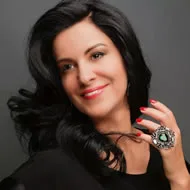
« Being a diva is an honour for me. »
Angela Gheorghiu, born in the Romanian small town of Adjud, received her vocal training at the Music Academy in Bucharest. She made her debut in 1992 at the Royal Opera House, Covent Garden. Since then she has been a sought-after guest at numerous international opera houses and concert halls. Engagements have taken her to New York, London, Paris, Venice, Brussels, Salzburg, Berlin, Milan, Rome, Barcelona, Amsterdam, Moscow, Tokyo, Chicago, Los Angeles and San Francisco, among others. Her repertoire centres on roles such as Violetta (La traviata), Nedda (Pagliacci), Juliette (Roméo et Juliette), Marguerite (Faust), Maria Boccanegra (Simon Boccanegra), Mimì (La bohème) as well as the title roles in Puccini's La rondine and Tosca.
Classicpoint.net: Your parents have nothing to do with music. Nevertheless, you and your sister have both become brilliant musicians. How did that come about?
I was very young. Before I started kindergarten, my sister and I were already singing. I can't remember ever doing anything with more pleasure and greater love! In kindergarten I sang my first proper song: Guten Abend, Gut Nacht by Brahms. I sang in Romanian and German. My father was a locomotive mechanic, my mother a seamstress, and indeed nobody in our family was a musician. My only contact with music was through television, with Leonard Bernstein's performances. We had no other recordings. Everyone who listened to me was very moved, and I loved that. Parents, family, relatives, friends, neighbours, teachers – all of them encouraged me, supported me and kept telling me that I had to study music and that I would be an opera singer. So at the age of 14 I went to the Music Academy in Bucharest and later to the conservatory. I enjoyed school, but at 18 I felt I was trained well enough. Since then I have not listened to anyone's advice, and everything I have achieved so far I owe to my singing teacher Mia Barbu. I don't believe there is a recipe, but through talent, hard work, perseverance, intelligence, musical instinct and sacrifice, anyone can become a great singer.
After the political upheaval in Romania, you left your homeland in 1990 and made your first appearances at the Royal Opera House in London. How do you remember that move?
I never left Romania for good; I have family and friends there. In 1992 I made my debut at the Royal Opera House as Mimì in La Bohème and Zerlina in Don Giovanni. My career has never included a permanent contract. I always knew what I had to do, and I always wanted to be an international artist on the largest and most important stages in the world, without being "tied" to one place or one opera. Such engagements were and still are customary, employed for several years at a single theatre. But that would have delayed my debuts at the other stages, and I would only have been able to start an international career much later. This "move" – the word is not very fitting – was normal for me, namely my natural path to a lyric singing career, for which I was ready. Moreover, perseverance, talent and hard work helped me on this path. I always knew what I had to do, and I made all my decisions with great wisdom.
What is your current relationship with your homeland?
Today I have a dual relationship with Romania. I love my country very much, I have family and friends there, but at the same time I don't like living in Romania. Almost 30 years after the so-called collapse of communism, the traces are more alive than ever. What I have seen in the last two years frightens me. No hospitals have been built, and motorways are missing, etc. Romania today is not a country with a secure future, and it still needs time to reach the level of the civilised countries of the EU. For so many years I have been waiting for an optimal concert hall to be built. There is only one hall, where communist party congresses took place, which is unsuitable for classical music, since orchestral concerts need a proper instrument. It is appalling. We only have the Romanian Athenaeum, which was built in the era of the kings of Romania. It is the jewel of the city of Bucharest. After 1990, everyone promised me – mayors, prime ministers and presidents – that they would build a new concert hall with international standards, and since then nobody has done anything.
After almost 30 years of career on the most important stages of the world, I am, I believe, the only international artist in music history who has not yet made a debut with an opera in his or her own country! I have never been invited. I have only given a few concerts, I think I can count them on my fingers, and they were honorary.
In Romania the mentality is different. As an artist of Romanian origin, one is still not recognised for one's true, international worth. Quite the contrary: one has to sing for a much lower fee or even for free. The people who run the state institutions think it would be presumptuous to demand the same rates as any colleague of another nationality.
The last time I was invited to a concert in Bucharest and was paid normally, as every foreign colleague of my stature would be, I was attacked in the Romanian media. Even the mayor of Bucharest joined in.
There is a lot to say about this. I would like to have more power to change things, but I can only be proud that I am Romanian and know that the Romanian people are talented, hard-working, but very open. There is no great Romanian artist with international renown such as Cioran, Brancusi, Eliade, Enescu, Ionesco, Darclée, Zeani or Celibidache who has not been accused or hated by politicians in the last 75 years. To this day that has remained the case. I hope this injustice comes to an end.
Everywhere in the world I am Angela Gheorghiu from Romania. I wish that the values in Romania were truly respected and that people would establish what we are and what we do. If other countries can do this properly, why do Romanian politicians and the media not force themselves to change their mentality and to see that one needs no fear of artists? We are enormously important for the people and for the identity of Romania. Culture is the passport of a nation.
You also like to sing Romanian songs. What characterises Romanian music?
I always enjoy singing Romanian songs. I sing at least one Romanian song in every concert or recital. It is hard to say what is characteristic of Romanian music. We could write a book about it. Romanian music brings together many influences, from French to Turkish or Hungarian. It varies greatly from region to region. However, I can say that Romanian music has a special rhythm; to some it sounds exotic, to others perhaps nostalgic. The audience is fascinated to hear me singing in Romanian.
The conductor Sir Georg Solti reportedly once said about you after a rehearsal: "I was moved to tears. I had to go outside. The girl is wonderful. She can do anything." What was your relationship with him?
For me, my relationship with Georg Solti remains one of the most beautiful experiences. Despite the great difference in age, we both actually began with La traviata – I had the role of Violetta, and he conducted this opera for the first time. Our relationship was on an equal footing from the start. I never felt patronised; on the contrary, we were colleagues from the very beginning. He offered me to call him "George". His strong emotions have stayed in my mind ever since! At his home I met great British personalities and great actors. I had the most beautiful memories with him. During rehearsals at the Royal Opera House, he once let the assistant conduct while he walked into every corner of the theatre to hear how my voice sounded overall and everywhere, in order to adjust the orchestra and the sound of my voice. For me it remains the only experience of this kind, and I am glad that it exists. Everyone knew that this Traviata would make history, and Georg Solti knew it too, more than anyone. And so it was. I will be forever grateful for his friendship and for his recognition of my talent. He fought for the performance to be broadcast live by the BBC, and he interrupted the regular television schedule to do so. It was the first time in history. He wanted us to be colleagues at DECCA too. He is the artist who supported me in my career with honesty, admiration and respect.
You have also appeared in film adaptations. The best known is probably the title role in the film adaptation of Tosca, directed by Benoît Jacquot. How did you experience this collaboration?
It was a very beautiful collaboration. I sang La traviata in Paris. After one performance, Toscan du Plantier congratulated me. He greeted me with the words "You are Tosca!" I had sung a very good Violetta that evening. In the third act I wore a red dress. This dress and my presence convinced him enough to give me the role of Tosca in his film, directed by Benoît Jacquot. It was earlier than I had planned to include this role in my repertoire. Scarpia had already been cast with Ruggero Raimondi, and I proposed Roberto Alagna for Mario Cavaradossi and Antonio Pappano as conductor. He was then permanently employed in Brussels and nobody knew him. They wanted a famous conductor, but I insisted. I am very proud of this film. Opera films are rare today. The experience of this film was wonderful for me. We launched the film at the Venice Film Festival and then screened it all over the world. The film brings out the characters, particularly through the very evocative rendering of facial expressions. It was a great joy to work at the highest level and with a superb director.
Would you describe yourself as a diva?
I'll let others do that! I thank those who call me a "diva". I have absolutely no problem with this word; quite the contrary, it honours me. For me, "diva" means a person of another dimension, hard to touch, who radiates a very strong emotion through her presence and, of course, through her talent. My friend, the great composer Vangelis, says that I am a diva, because when he hears me and looks at me, time stands still!
Today the word has lost its charm; everyone is a "diva", and even men are called "divos" ... but for me the word "diva" or "the last reigning diva", "the ultimate diva" etc. are expressions that make me happy, honour me and even motivate me.
You were a dream team together with Roberto Alagna. Ultimately, did mutual success lead to the separation?
On stage there is indeed a magic in the voices, something special. That is why we were a "dream team". Neither of us was carried away by the other, but we both created unique moments through our voices in duets. It was not personal success that led to the separation, but personal problems that actually have nothing to do with success. Each of us was already successful before the wedding; we were both young and already well known in the professional world. Success is one thing, personal life is another. I persevered in order to develop my career further, but it was not always easy. Personalities that were too strong, that is the truth. For each of us, life goes on.
Which tenor today suits your voice best?
That is hard to answer. I will say again that I have no problem singing with Roberto; the audience wants that... And why can we not be professionals and do it when such an opportunity arises? Otherwise, I think there is a vocal "chemistry" with the tenors Jonas Kaufmann, Vittorio Grigolo or Joseph Calleja.
You are very passionate and uncompromising. Are there things you would do differently in hindsight?
I am who I am, and I have always been so. I never think about what might have been if... I don't have these thoughts and I live my life very much in the present, both professionally and personally. I am an honest person and artist who always calls things by their name, even though I sometimes risk upsetting someone with the truth. I cannot be otherwise, and I have no reason to be. Perhaps this sincerity has sometimes harmed me. In the past I have said "no" to many production requests, but that was because I respect the music, the composers and the librettists. I cannot make ridiculous the work of a genius that can move so many people through my interpretation. It is as if I were to pick up a brush now and paint over a Caravaggio. Would that be all right?
Do you have rituals before or after concerts?
Of course I do, yes. I think all artists do. I cannot reveal all of them, but I can say that on the day before a performance I always try not to speak at all; I rest. I protect my voice. I make many sacrifices; often I see nothing but the aeroplane and the hotel room before my eyes. I must not risk a cold or illness... and I accept no advice; I prefer to be authentic in my success, but also in my mistakes, if I make any. I follow no one and have no role model. That is who I am, and that is how I built my career. I cannot be otherwise.
Is there anything you have never been asked but would like to answer?
Yes, there is the question: when will I sing at the Metropolitan again?
Interview by Florian Schär | Classicpoint.net | 4.2.2019
© Image: Ionut Macri
More interviews
All interviews →


