

«Everyone simply hears everything.»

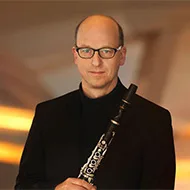
The clarinet was the «reward» for Alexander Bader for passing the entrance examination as a junior student in piano at the Hochschule der Künste Berlin. The silvery glint on black wood and the soft, warm sound fascinated him from the start, so he studied this instrument alongside his main subject, also at the HdK Berlin. Formative teachers were Manfred Preis and Peter Rieckhoff. After completing his orchestral diploma, he moved into the soloist class of Wolfgang Meyer at the Staatliche Hochschule für Musik Karlsruhe and, while still in his final examinations, became a member of the Deutsche Kammerphilharmonie Bremen in 1990. In 2002 he joined the Komische Oper Berlin as Principal Solo Clarinettist; alongside this he regularly played at, among others, the Bayerische Staatsoper Munich and with the Munich Philharmonic. In 2006 Alexander Bader became a member of the Berlin Philharmonic Orchestra. Since 1994 the clarinettist has also devoted himself to historically informed performance practice on original instruments and regularly performs with ensembles such as Concentus Musicus Wien, the Balthasar-Neumann-Ensemble and the Akademie für Alte Musik Berlin. Since the 2006/2007 season, Alexander Bader has been a member of the Scharoun Ensemble Berlin.
You first studied and completed piano before clarinet?
As a child I already played piano; that was a great love. Then I became a junior student at the Hochschule Berlin at 11, and as a reward I was allowed to choose a second instrument. I chose the clarinet more or less by chance. At first I neglected it, since the piano offered me more. Then I finished my Abitur and the question was what I should study. I decided on the clarinet. In the end it was a cost-saving measure by the Hochschule that forced me to take the entrance examination. After passing it, I could study piano and clarinet at the same time. But studying both together was hard, and at some point the piano shifted from being a course of study to a hobby.
Were there other students who studied in parallel?
Well, I know people who studied mathematics alongside music. But two instruments at postgraduate level is very demanding, and I must admit that my piano studies increasingly fell by the wayside.
Do you still play the piano?
Yes. With family and the many commitments with the clarinet, it of course became difficult, but now that the children are getting older, I am increasingly finding time for it again.
You are a member of the Berlin Philharmonic. What sets the orchestra apart for you?
I can tell you clearly. After experience in several other orchestras, within the first few weeks I was so overwhelmed by the quality of every single player. Not only the first violins, but everyone was incredibly good. If someone is not ideal, it stands out immediately. That is my greatest incentive. It naturally also drives you on together. And if a mistake happens, then someone very far away may turn their head, simply because everyone hears everything.
But that must also generate quite a lot of pressure?
Yes, of course, at the beginning it was quite difficult. But thanks to the two probationary years, it becomes clear that you have really made it. Because you might be able to pretend for one year, but in the second year your true self shows. You can perhaps compensate for everything for one year with great effort and practice, but you cannot do it over two years. You simply have to be at this level.
You are also a member of the Scharoun Ensemble. What appeals to you about it?
Next year this is a 40-year-old ensemble, which was formed from special people. The Scharoun Ensemble takes its name from the architect of its home venue: with the Berlin Philharmonie, Hans Scharoun (1893–1972) created a concert hall unique in the world, which dares to synthesise innovation and a sense of tradition and opens up new paths of artistic communication – ideals to which the Scharoun Ensemble also feels committed. I was already enthralled as a student and listener. And when I then joined the orchestra, I was lucky that my predecessor had just stopped and I was approached as his successor. We always want to create something more sustainable, for example by playing with young people. They then go on to build their careers, and later you meet them at concerts in New York and other major cities around the world. At the Zermatt Music Festival we work with the students over two years. That creates a bond.
When you are in Zermatt, do you also go hiking?
Yes, as long as you are not a morning grump. Usually you then have a half-day off, and then you simply have to get up at 4 a.m. We also do an organised hike, always on the Sunday after the first week, when we go out with the students. There is also a group of students who race each morning up to the Edelweiss hut.
You also devote yourself to historically informed performance practice. How did that come about?
It began during my studies. I was advised to learn something else as well as the examination material. I was handed the instrument and simply started. Admittedly at first a little haltingly, but it also helped me with modern instruments. You play much more like a singer and learn how to handle the breath. I then quickly received many invitations to perform, because the scene was still small. It was also unusual for someone from the modern world to venture into this field. When our second child came along at home, I stepped back a little, because you are hardly ever at home; you always go to rehearsals first and then there are the many concerts and tours. After the fourth child I decided to step back completely. I sold all my historical instruments, so that I would not even be tempted again. I was glad to have closed that chapter for the time being.
And what about solo performances?
That is no longer so prominent either. Perhaps one or two performances a year. But this year is special in Zermatt, because we have a harp with us, and we were still considering what we could play. I then suggested Copland's Concerto for Clarinet and Strings, since I had just been playing it anyway, and we agreed on it.
If you could ask a deceased composer one question, whom would you choose and what would you ask?
I would choose Mozart, but I think I would not need to ask him anything, since he would talk on his own. Mozart is so unique and so moving to me. Is he still a human being, actually? Because this simplicity is so outstanding, and I wonder how a person can achieve such moving simplicity.
Do you have interests outside music?
I am an enthusiastic flyer of paragliders and kites. I obtained my licence in 1989, but that then lapsed somewhat with family life. And of course there are dangers, but I find riding more dangerous. Three years ago I took up paragliding with my older sons. It is very simple: you have everything in your rucksack and can simply take off whenever you want.
Interview by Florian Schär | Classicpoint.net | 20 July 2021
More interviews
All interviews →


