

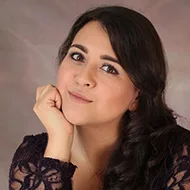
«I didn't become interested in classical singing until I was 16.»

Adriana González is an internationally sought-after opera soprano from Guatemala who delights audiences and critics alike with her warm, lyrical voice and musical depth. Born in 1991 in Guatemala City, she began her musical training at the Universidad del Valle de Guatemala before continuing her career in Europe. She was a member of the renowned Atelier Lyrique of the Paris Opera and later of the International Opera Studio Zurich, where she quickly established herself as an outstanding interpreter of Mozart and Puccini roles.
Her international debut came with roles such as Zerlina, Despina and Pamina, followed by appearances as Micaëla (Carmen), Liù (Turandot) and Mimì (La Bohème) at leading houses in Berlin, Paris, Frankfurt, Geneva and Salzburg. In 2019 she received the first prize and the Zarzuela Prize at the prestigious Operalia competition – a significant milestone in her career.
Alongside her stage work, Adriana González is also active as a recital singer. Her recordings of Spanish and French songs have been honoured with the Preis der deutschen Schallplattenkritik (German Record Critics' Award). Combining technical finesse, emotional expressiveness and natural stage presence, she is today regarded as one of the most promising sopranos of her generation.
You grew up in Guatemala. What do you appreciate most about your homeland?
Guatemala is a very green country with excellent weather conditions. I grew up surrounded by mountains and volcanoes, which provided a wonderful backdrop that inspired me. The country's history goes back to 2000 BC. It is not only rich in Maya history and traditions, but also distinguished by regional climatic and ecological diversity. If you are looking for a new destination to reconnect with nature, you should consider Guatemala.
How did you discover your voice?
That was during my school years – I sang with friends in a rock band. Singing gave me the opportunity to express myself in a very unique way. We played music by the Beatles, Radiohead, Damien Rice, Ricardo Arjona, Malacates Trebol Shop and others. When I listen to Ella Fitzgerald and Nina Simone, my thoughts also turn to jazz. I began singing at home in my living room and needed some time to build the confidence to sing in front of an audience.
When did you first hear opera?
I knew early on that opera existed, as my mother played CDs of Maria Callas and Joan Sutherland at home. But I didn't become interested in classical singing until I was 16.
Which roles fascinate you most and why?
It is difficult to choose just a few roles, so I would rather say that I love Puccini as a force of human emotion. His heroines have always been a source of pure, deep and intense feeling for me. When I first sang Liù, Mimì or Suor Angelica, I wept a great deal during rehearsals and performances. Although the music evokes sadness, I always find light and happiness in Puccini's harmonic shifts and his orchestration. He has shown me that death, despite extreme suffering and sacrifice, can also be full of light and hope. Every role can become a discovery through study and hard work, but music that speaks to the soul and personality cannot be forced; it is simply within the person.
Do you have rituals before a performance?
I always try to rest as much as possible and keep my surroundings free of stress. Lately I have also been spending my days in a lovely, slow Pilates class, which helps me with posture and breathing. With so much travel and the mental, physical and emotional demands of this profession, our bodies need space, time and movement to keep everything in balance.
Do you also enjoy concerts and song recitals?
Yes, I love song recitals. They are more intimate than opera, as the format is smaller: just the singer and the pianist. Together with the conductor Iñaki Encina Oyón, we have been presenting various programmes for 10 years now. Our focus is on bringing unfamiliar music into concert halls. Our first album was also dedicated to a French-Greek couple: Robert Dussaut and Hélène Covatti. Our second album was devoted to the songs of Isaac Albéniz, which are likewise rarely heard. Of course, programming unfamiliar music is a risk, but in most cases people are pleasantly surprised and curious to discover more.
What was your craziest experience during a performance?
The craziest... Probably the production of “La finta giardiniera” by Tatjana Gürbaca, when I was still at the Opera Studio in Zurich in 2018. It was so creative, and towards the end it filled the stage with foam. The process was intense, but once all the technical details were resolved, we had a great deal of fun on stage. Gianluca Capuano also contributed a lot of fun with the tempi and the orchestral textures. A very crazy experience!
What do you hope to achieve as an artist?
Of course, one can never control the mood in which audiences come to the opera. Regardless of what people bring with them into the theatre, I would be happy if visitors left the theatre inspired by the intoxicating power of music and its beauty. During a performance I always give 100 % in order to inspire people or at least bring them to dream for a brief moment. I am an idealist, so I would be delighted if, thanks to music, people could forget their worries and imagine all the good that could be.
What are your passions besides music?
I love photography and cooking. Art in general is always inspiring, but sculptures fascinate me in particular.
Interview by Florian Schär | Classicpoint.net | 01.07.2025
© Image: Marine Cessat-Begler
More interviews
All interviews →


