

Homage to Klaus Huber
Musikkollegium Winterthur · Roberto González-Monjas, Leitung · Flurin Cuonz, Violoncello · David Eggert, Baryton · Elmar Hauser, Countertenor · Sérgio Pires, Klarinette
Programme
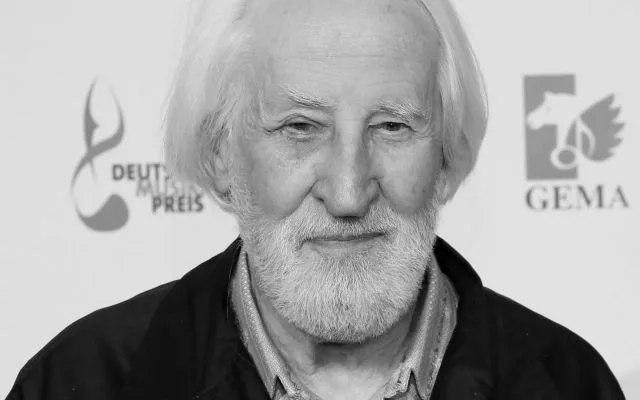
Klaus Huber (1924–2017) shaped his era as a composer and teacher, with sounds and words alike. The arc of his work spans from the Swiss-inflected neoclassicism of the postwar years to the transcultural openness of the 21st century. «Die Seele muss vom Reittier steigen», a chamber cantata of 2002, reveals exemplary facets of Huber, not least a striking, sensuous fragility of sound. Huber shares the idea of the power of the fragile with the Palestinian poet Mahmoud Darwish, whose lines have evidently kindled his creative fire. The work lasts a good half hour and brings together many of Huber's interests: silence and outcry, microtonality and the Arab tonal system, mysticism and political engagement. For Huber, this also includes 'untimely' instruments such as the baryton, which fell out of fashion around 1800, and the high vocal part, which combines Baroque sound worlds with Arabic inflections. The rising Winterthur countertenor Elmar Hauser will sing, whisper and embody this part.
Roberto González-Monjas, in turn, follows in Huber's footsteps to weave a meaningful web of laments across the epochs. Back to Henry Purcell's closing song from «Dido and Aeneas», one of the most beautiful and saddest pieces of music ever written, and forward to Olivier Messiaen's apocalyptic «Abîme des oiseaux» for solo clarinet, culminating in the powerful climax: «Die Seele muss vom Reittier steigen und gehen auf ihren Seidenfüssen…»
Programme
Henry Purcell – «When I am laid in Earth», Dido's Lament from the opera «Dido and Aeneas»
Klaus Huber – «Ein Hauch von Unzeit III» for variable ensemble
Antonio Vivaldi – Sinfonia in B minor «Al Santo Sepolcro» RV 169
Olivier Messiaen – «Abîme des oiseaux»
Henry Purcell – Chaconne in G minor, Z 730
Klaus Huber – «Die Seele muss vom Reittier steigen...» for violoncello, baryton, countertenor and two orchestral groups. Text by Mahmoud Darwish